Willamette University’s Pacific Northwest College of Art is reimagining arts education with a revised general education curriculum. Designed to equip emerging artists and designers with the tools to tackle complex, real-world challenges, the updated model builds a dynamic shared core curriculum while vastly expanding interdisciplinary and career-focused opportunities.
“Our reimagined curriculum is built on the belief that today’s artists must also be innovative problem-solvers and resilient professionals,” says Jen Cole, Jordan Schnitzer Dean of PNCA. “By breaking down academic silos, we are empowering students to bridge the gap between their creative passions and the very real civic and global challenges of the future.”
The move makes PNCA the only school in the Association of Independent Colleges of Art and Design (AICAD) consortium to implement an applied creative practice curriculum of this kind in the nation. Rather than siloing career preparation outside of the classroom, the curriculum embeds applied creative practice and professional development into every facet of the PNCA experience. It builds on traditional topics like history, math, science and literature and presents new multi-disciplinary seminars where students can explore big topics through multiple humanities and sciences lenses. Professionalization is a focus of the curriculum from a student’s first seminar course all the way to the senior capstone project, in which students leave PNCA with a comprehensive portfolio of professional documents and work samples that will set them up for success.
“This work has been years in the making and is grounded in what we’ve learned from our alumni, faculty, students, and national research about how we can best prepare artists and designers for meaningful creative careers,” Cole said.
Building a strong foundation
The new curriculum centers on three core components: Foundation Studies, Interdisciplinary Seminars, and Applied Creative Practice. During their first year, all students complete Foundation Studies, which establish a shared understanding of key concepts spanning creative and intellectual disciplines.
As Oregon’s premier art and design school, the foundational academic experience includes a strong connection to the city of Portland. In the Place-Based Inquiry course, students utilize diverse lenses — including biology, economics, and cultural history — to root their artistic learning within the local community and broader ecological and economic systems. Throughout the curriculum, students learn how their work can contribute to the needs of the city, state, region, and beyond.
Tackling complex problems with interdisciplinary courses
To foster intellectual agility, PNCA has introduced Interdisciplinary Seminars that seamlessly integrate the arts, sciences, and humanities. The seminars give students the tools to tackle complex, interconnected problems the way they are actually solved: through many different lenses at once.
Students are encouraged to tailor their coursework to their specific interests, exploring dynamic topics like digital culture or the intersections of economics, data science, and creative markets. These seminars also tackle quantitative reasoning and the ethical implications of artificial intelligence, ensuring students are prepared to innovate in an increasingly interconnected world.
Connecting the classroom to the creative economy
The cornerstone of the revised curriculum is the Applied Creative Practice sequence, a four-year progression of hands-on, experiential learning that is embedded into every step of the PNCA academic journey. The sequence begins in the first year with Introduction to Creative Citizenship. This course introduces students to modes of creative work and encourages students to think critically about the world and positions them to engage thoughtfully with the challenges they will face in their careers. Then, beginning in their second year, students pitch public-facing projects — such as social impact endeavors, exhibitions, or public art — to build their professional portfolios.
As they progress into their third year, students explore creative entrepreneurship, financial budgeting, and intellectual property.
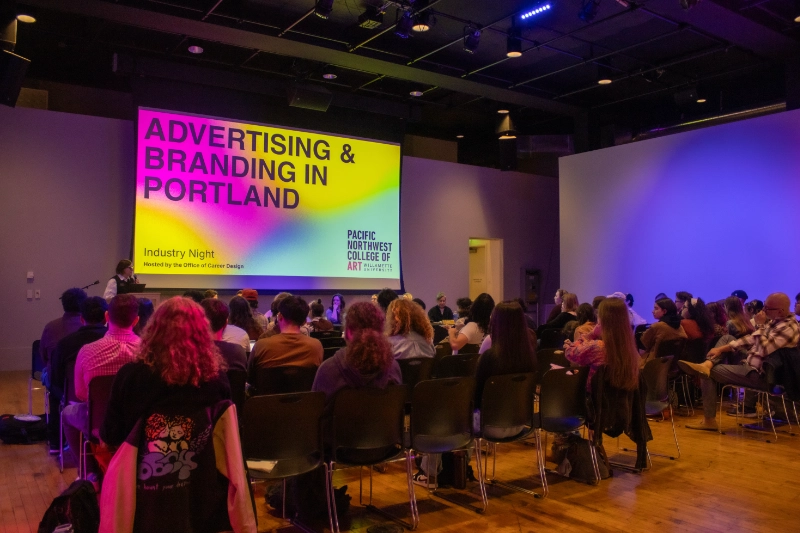
The curriculum culminates in a Senior Seminar focused on networking and career launching, working in close consultation with PNCA’s Office of Career Design. They will formalize their dossier of professional documents, portfolios and their online presence.
By the time they leave PNCA, students graduate not just as talented creators, but as confident professionals ready to thrive in the creative economy.