The governing boards of Willamette University and Pacific University have unanimously ratified an agreement to merge, creating the largest private university in Oregon.
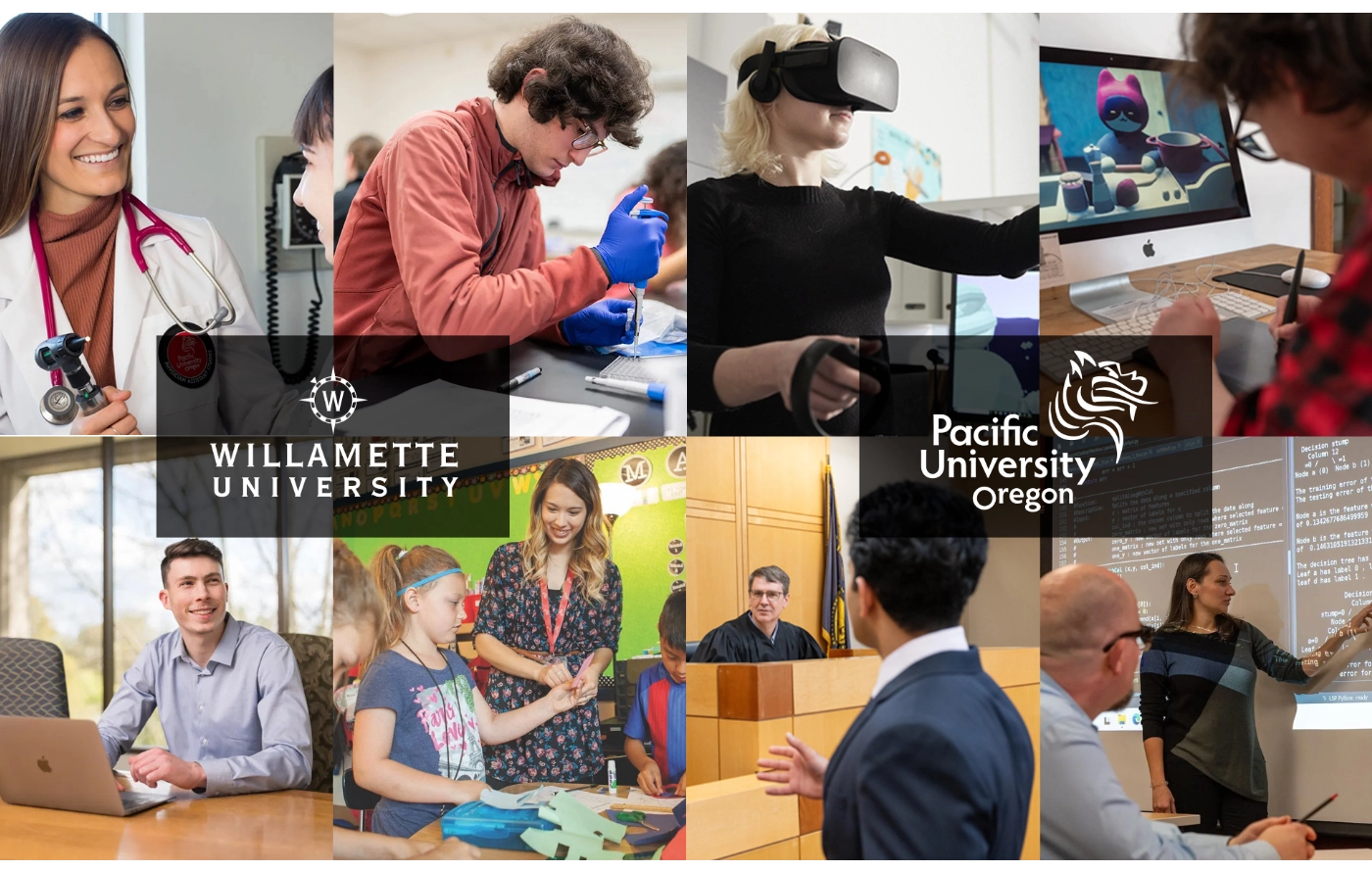
The unified university will serve more than 6,000 students across Willamette and Pacific's campuses in Salem, Forest Grove, Hillsboro, and Portland. It will combine an academic portfolio spanning the liberal arts and sciences, business and management, law, education, optometry and healthcare, computing and data science, and art and design. And it will bring together an alumni network more than 73,000 strong.
In a challenging time for higher education, Willamette and Pacific plan to combine their strengths to expand academic offerings, broaden access, and deepen the opportunities for students across the region.
“This merger is built on shared values, complementary missions, and a common purpose,” said Pacific University President Jenny Coyle. “As institutions across the country are having to do more with less, we decided we want to do more with more.”
“So many universities in Oregon have been retrenching, cutting programs and support for students,” said Willamette University President Steve Thorsett. “We felt that this is a moment not for retreat, but for innovation and leadership. By combining Willamette and Pacific's distinctive strengths, we intend to build a university with the scale to thrive and to maintain the academic quality we’re both known for.”
Willamette and Pacific are expected to come together under a single nonprofit entity, led by a unified board of trustees. During this phase, each university maintains its own accreditation, degree-granting authority, and participation in federal financial aid programs. After a transitional period and receipt of additional regulatory approvals, Willamette and Pacific will officially combine into a single university. Thorsett and Coyle will jointly lead the combined university. As chancellor, Thorsett will oversee business operations, and as president, Coyle will oversee academics and student affairs.
Expanding regional leadership
Willamette, founded in 1842, and Pacific, founded in 1849, are the oldest universities in the western United States.
For nearly two centuries, both have championed the role of nonprofit private universities in innovating to serve the needs of their communities.
Willamette launched the state's first medical school and law school, and includes the state's first professional art and design school, PNCA. The university has produced generations of leaders, changemakers, and artists who have shaped the region's civic, legal, cultural, and creative fabric. Pacific launched the state’s first degree programs in teaching, optometry, occupational therapy, and physical therapy, and today it is the No. 1 private educator of healthcare professionals in Oregon.
Together, the universities expect to bring greater capacity to meet the workforce needs of the region, particularly in healthcare, law, and education, where the region’s shortages are most acute.
Preserving distinctive schools
A merger of equals, the combined university will adopt a collegiate model that is rare in American higher education. Each school and college of Willamette and Pacific will maintain their name within the combined university, along with their history, traditions, athletics programs, and the unique identities that are central to student life and alumni pride and connection. Admissions processes also will remain connected to the individual schools and colleges.
Next steps
Unanimously approved by both boards on June 6 and signed in early July 2026, the agreement advances the merger from the letter of intent announced in December 2025 to a binding plan.
The merger of Willamette and Pacific into a single legal entity — provisionally named the University of the Northwest — is expected by the beginning of 2027, subject to closing conditions and regulatory and accreditor approvals.
The subsequent combination of Willamette and Pacific into a single higher education institution could take up to two years to complete, pending additional required regulatory and accreditor approvals.