You find yourself trapped in a room with no way out. Surrounded by strange objects, locks without keys, and clues to decipher, your task is to solve the puzzle and escape before the timer runs out.
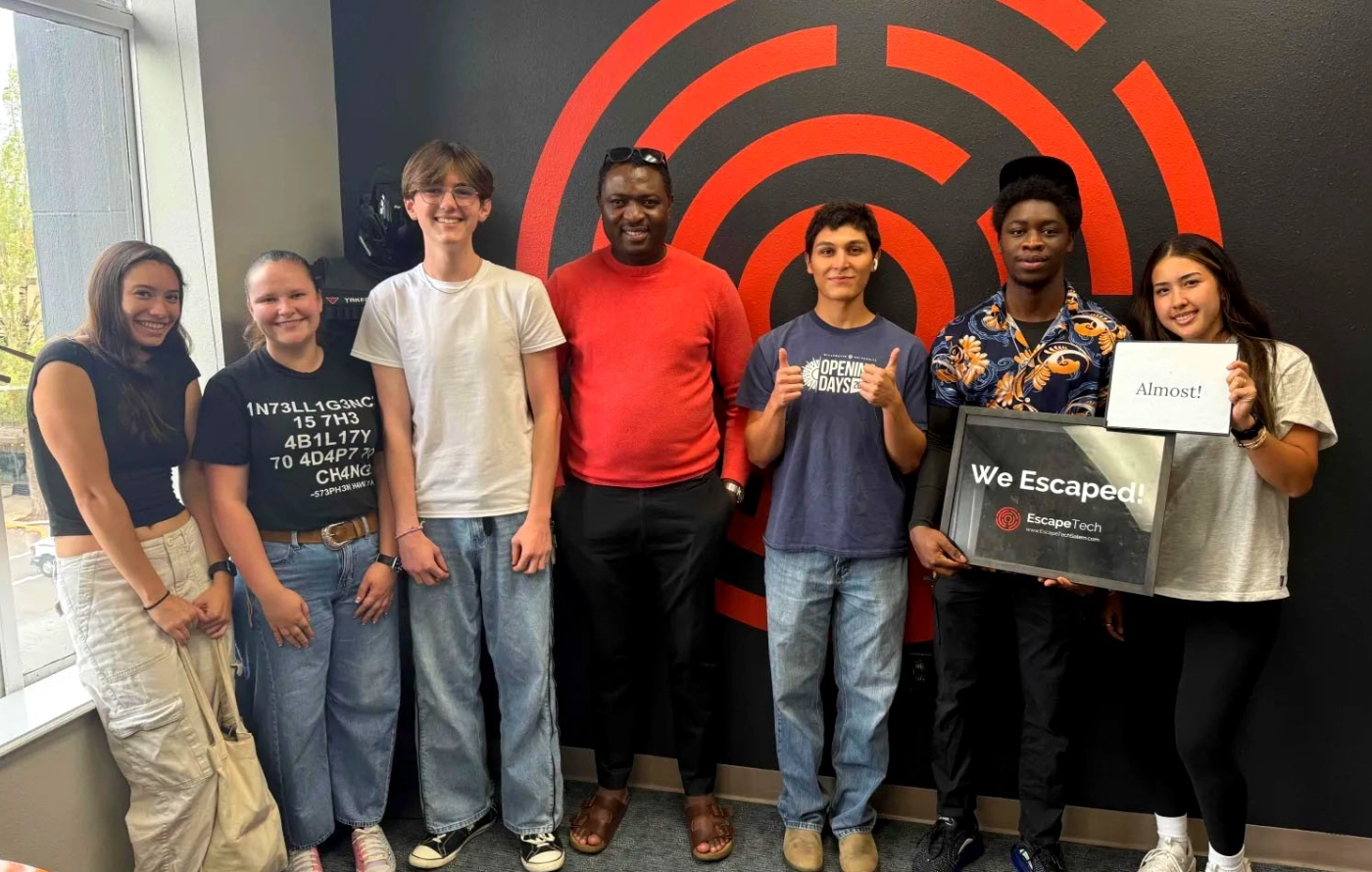
That’s the challenge Willamette University students in Assistant Professor of Computer Science Fred Agbo’s Human-Computer Interaction course experienced when they tackled an escape room just a few minutes from campus in downtown Salem.
It wasn’t just a fun day out of the classroom — it was a hands-on demonstration of why design matters. Rather than just reading about design principles, they experienced them. For Agbo, an escape room — a live-action puzzle where participants work together in teams to find a way out — is a powerful illustration of the consequences design decisions can have for different kinds of users.
“I remember leaving that experience thinking, ‘Oh, I get it,’” said Ben Webster BS’27, a Computer Science and Data Science double-major and Mathematics minor. “It was an immersive way of driving home that idea of looking at design from the shoes of the user.”
As they explored the room, students were encouraged to consider the perspective of different kinds of visitors, such as visually impaired participants or those with limited mobility.
“This experiential approach allowed students to deconstruct user flow and emotional responses in real-time, moving them from a purely technical mindset to a deeper understanding of human-centered design,” Agbo said.
Decisions made by the room’s designers — from the font size on instructions to the placement of clues around the room — could unintentionally exclude some visitors. It’s a striking example of the barriers that Agbo has previously studied in his research on adult computer literacy, where design choices can shut out older users from the benefits of technology.
The escape room trip is just one of the many hands-on experiences that Willamette’s School of Computing & Information Sciences faculty are using to empower the next generation of designers, analysts, and technology leaders. Whether it’s designing better AI models for learning, harnessing data to help the Bearcat soccer team maximize their competitive edge, or using LEGO robotics to help bring STEM to life for elementary school students — Willamette students learn to always put practical applications and people at the center of their computer and data science education.
“The experience caused me to think about all the possibilities that need to be considered when creating interfaces for people,” said Computer Science major Jessica Liu BS’28. “It shifts your focus towards a user's experience and their needs versus the creators wants and needs, so that both can be addressed.”
Webster says that once you start to pay attention to these human-computer interaction design principles, you don’t ever see things the same way.
“It’s important to think critically about the ways that you are or are not being centered in the design process of the things that you use — whether it’s a computer program or a vacuum cleaner,” Webster said.
While the students didn’t quite complete the escape room in time that day, they left with an important lesson on how the world is engineered — and how they can build it better.