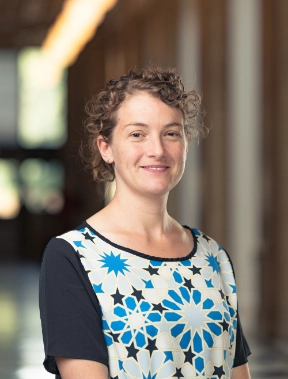
 Willamette University’s Pacific Northwest College of Art faculty member Kate McCallum recently presented at the International Congress of Qualitative Inquiry (ICQI), where she explored the question: How do different academic disciplines create knowledge?
Her talk, “Creative Diagramming of Knowledge Production Across Disciplines,” used arts-based methods to visualize how scholars transform data into insight. As co-facilitator of the Arts-Based Research Special Interest Group (SIG), McCallum also led a workshop reimagining the academic paper through poetry, visual art, and creative reconstruction. Her work sparked new collaborations, inspired an upcoming open-access publication, and ignited plans for an ambitious exhibition that blends research artifacts with large-scale diagrammatic installations.
At PNCA, McCallum’s interdisciplinary perspective is on full display in her Data Visualization class, which helps students bring together technology, data analytics, and art to hone their visual communication skills.
We caught up with McCallum to learn more about her work, perspectives on interdisciplinary study, and the future of the arts and technology.
The intersection of data analysis and art is an interesting area of study for students at PNCA to explore. What inspired you to develop this course?
If you want to get things done in today's world, it is a very good idea to support your arguments with data. That can make your ideas more realistic, responsive, and also more credible, and working with the numbers is what allows us to engage the bigger picture and place things in context.
PNCA students tend to be remarkably thoughtful and politically aware; they are also exceptional visual communicators. I developed the Data Visualization class to create a space in which students could bring those skills and interests together, and see where they could take it, with the goal of creating visual data narratives that would allow them to advocate for the changes they want to see in their world.
The students took that challenge and ran with it down radically different paths, engaging everything from the climate to contemporary conflict to mental health challenges experienced by students. Ultimately, I hope that they left feeling empowered to speak to the really big questions, knowing that they have the skills to back it up.
How does interdisciplinary study benefit students who wish to pursue a career in the arts?
Artists are pretty interdisciplinary beings. We are all, all the time, thinking in ways that cross traditional boundaries and make new connections between ideas. We read about science, hear oral history from those around us, reference both when we talk about politics, employ storytelling when we put that in an email to a friend, and all of that might end up informing and shaping the game we design three years later.
In an academic context, what we want to add to that is an awareness of the methods and philosophical assumptions of different fields of work. That brings rigor and robustness to our work, as well as keeping us accountable. I find that much of what I do as an educator consists in helping students to recognize and value the curious mindset they are already bringing to their work, and then to hone their methods to truly test their assumptions and learn more.
I believe that it is very important to fully appreciate the practices that have been developed in the traditional disciplines of academia, and also that building upon those can mean stepping across some of those traditional boundaries, and seeing what happens when we bring different sets of assumptions into relationship with one another. I see thinkers like Robin Wall Kimmerer exploring what it means to hold multiple ways of knowing at the same time, and I hope that we are moving into a moment in which we can acknowledge different systems of thought without trying to establish dominance of one over another.
How does PNCA prepare students to navigate the changing landscape and account for the impact of AI?
PNCA students bring an incredible critical engagement with the GenAI landscape, which is fantastic to see. What we need to do now as educators is to provide our students with the technical and contextual knowledge to intentionally shape this rapidly changing world, and be competent participants in their professional fields, whatever that looks like for them. That might mean learning how to work productively with GenAI, or it might mean being able to articulate their unique contribution as a creative human in the context of GenAI — or, probably, both. In any case, I and other PNCA faculty members are focusing on providing students with that technical grounding and awareness that will allow them to be informed participants as our world is radically shifting.
You were recently a featured presenter at the International Congress of Qualitative Inquiry to speak about arts-based research methods. Why is it important for others to be considering this research and what inspiration do you hope attendees left with from your presentation?
There is a growing awareness that arts-based forms of inquiry have great value for seeing things anew, whether that be in organizations, academia, or the wider world. In institutional or even corporate settings, artists in residence are invited in to provide viewpoints that challenge accepted norms and provide generative friction. That can look like work that speaks to the full human, that is empathetic, embodied, and sensory, or it can look like work that directly challenges the assumptions of the world as it is encountered. In my session at ICQI, we proposed radical reworkings of traditional research forms like the academic paper, and explored what it means to be rigorous as you change the rules. That part is important — it is worth emphasizing that artists are not there to provide light relief, but bring intellectual rigor based in their own practices.
What collaborations and exhibitions do you have planned for the future that relate to this work?
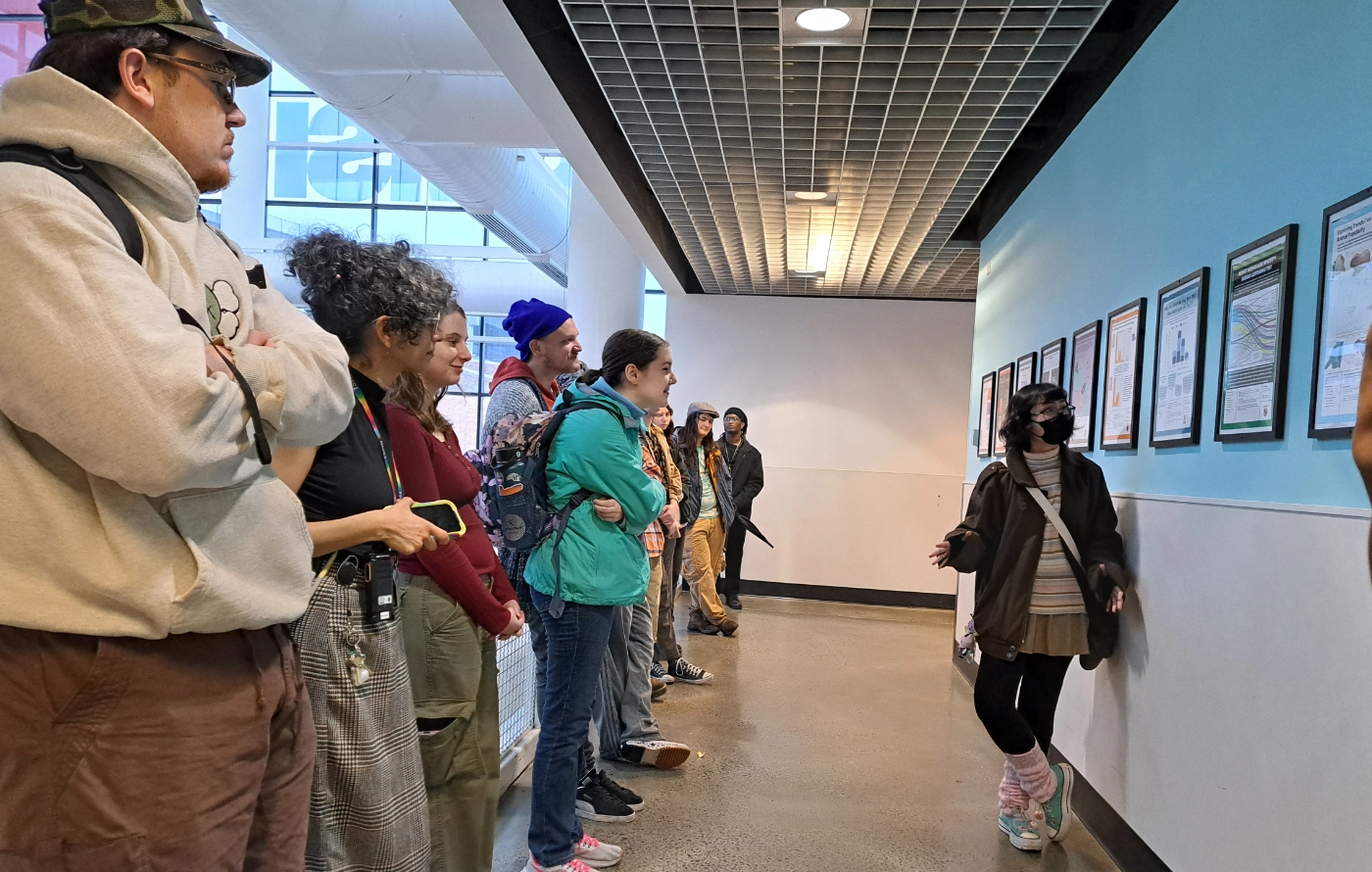
Students in my AI Theory and Skills class are working on a poster exhibition on climate futures, which is also a collaboration with PSU's Climate Science Lab, to tie in with the opening of OMSI's new Climate of Change hall. They are confronting the environmental impacts of AI head-on, looking at its current and potential implications and envisioning what the Portland metro area will look like, all while developing their own intentional framework for the use of AI.
(Editor's Note: McCallum is mounting an exhibition of her own work in March entitled AI and Power: Cyborg Storytelling on the Intersections of Machine Intelligence and Imperialism. Keep an eye out for more information about that event.)
Since this is for our special AI issue of Knowledge Into Action, we have a bonus question. What are some of the creative ways you've seen students engage with AI in their coursework or projects?
I saw one student develop an app that would act as a sort of impartial coordinator to coach students in how to collaborate in group projects, assigning roles, sending nudges about deadlines, and offering ways to ensure an equitable division of work. Knowing how anxious students can feel about group projects, I felt like that one would find an enthusiastic market! Another student just last week created a game that had no objective and no way to win, and only when you had 'lost' would reveal to you the message 'WRONG BUTTON' and the count for your 'Chaos Level.' It was completely unexpected and broke all the rules of traditional games, and it was wonderful.