The creative spark has always been thought of as a distinctly human characteristic. And yet, advances in technology are bringing this once-exclusively human experience into question as artificial intelligence tools are deployed across many creative industries. Art and design professionals are adjusting to these rapidly changing technologies and reinventing creativity along the way.
At Willamette University’s Pacific Northwest College of Art, professors are motivating students to tackle some of the big questions around technology and creativity, all while gaining important skills to take with them into the future.
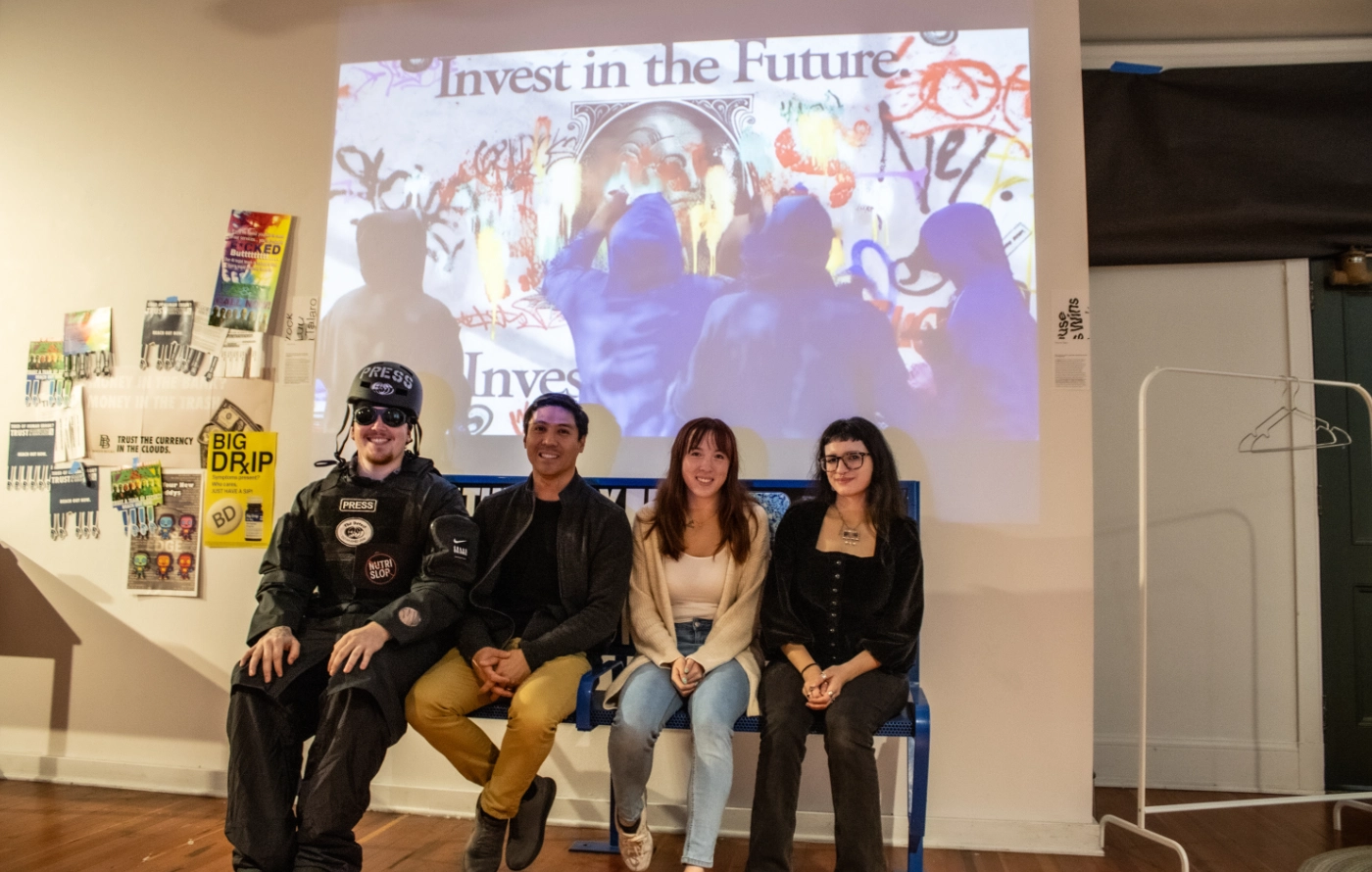
Assistant Professor of Graphic Design Salvador Orara asked students to consider a future where AI has replaced most human tasks including graphic design. The result was a mini-exhibition of discursive design titled The House Always Wins. The collection, created by students Jack Brock BFA’27, Leilani Luu BA/BFA’26, and Paloma Talaro BFA’27, centered around the provocative idea: “AI promised efficiency, stability, and comfort; but left humanity broke, dependent and starving. The only game left to play is survival, and the house always wins.”
Orara recognized that the type of close student-faculty collaborations common at PNCA play an important role in equipping students to better orient themselves within constantly shifting landscapes post-graduation.
“Some of my most influential instructors never enter the room with answers; they create conditions for creativity to bloom. This course was designed as a shared interrogation of possibilities, not a delivery of conclusions or solutions,” says Orara, “This mirrors professional contexts where designers are rarely sole authors, but participants inside systems with competing beliefs, values, constraints, and responsibilities.”
The course encouraged students to explore AI as a tool in design to experience how it can benefit or hinder the creative process — reflecting how designers approach AI ethically and critically.
Luu — who is studying graphic design at PNCA and business at Willamette’s Salem campus — sees value in students exploring how AI can enhance their working process as part of their education.
“I believe it is important to provide a space where students can explore these concepts,” Luu says. “Whether you like it or not, AI is becoming prevalent, especially in the design world, and job requirements are even asking that you understand how to use tools that use AI.”
For Orara, PNCA is well-equipped to approach the complex ethical and practical questions AI raises for artists and creative professionals.
“AI pushes questions of integrity, accountability, and reflection to the surface — questions that feel especially aligned with PNCA’s values,” says Orara, “Teaching this course reinforced an emphasis away from output and toward intent, framing, and accountability. Students were encouraged to treat AI as something to interrogate, not a shortcut to results.”