As data collection and analysis technology becomes more advanced through machine learning models and computer vision, opportunities to apply them to fields such as ecology create faster and more impactful approaches to understanding the behavior of various ecosystems. Assistant Professor of Data Science Zechariah Meunier, the newest addition to the faculty of Willamette University’s School of Computing & Information Sciences, is conducting student-faculty research combining biology and data science to study Oregon’s coastal ecosystems and help inform policy decisions.
“As a quantitative ecologist focusing on community ecology, my work tracks many species present in one place and time, not just a select few. So I need more complicated multivariate methods in order to track and better understand how these systems are changing,” Meunier shares. “I’m also currently working on an R package as part of my research to apply scientific machine learning methods to better model ecosystem dynamics and predict future changes.”
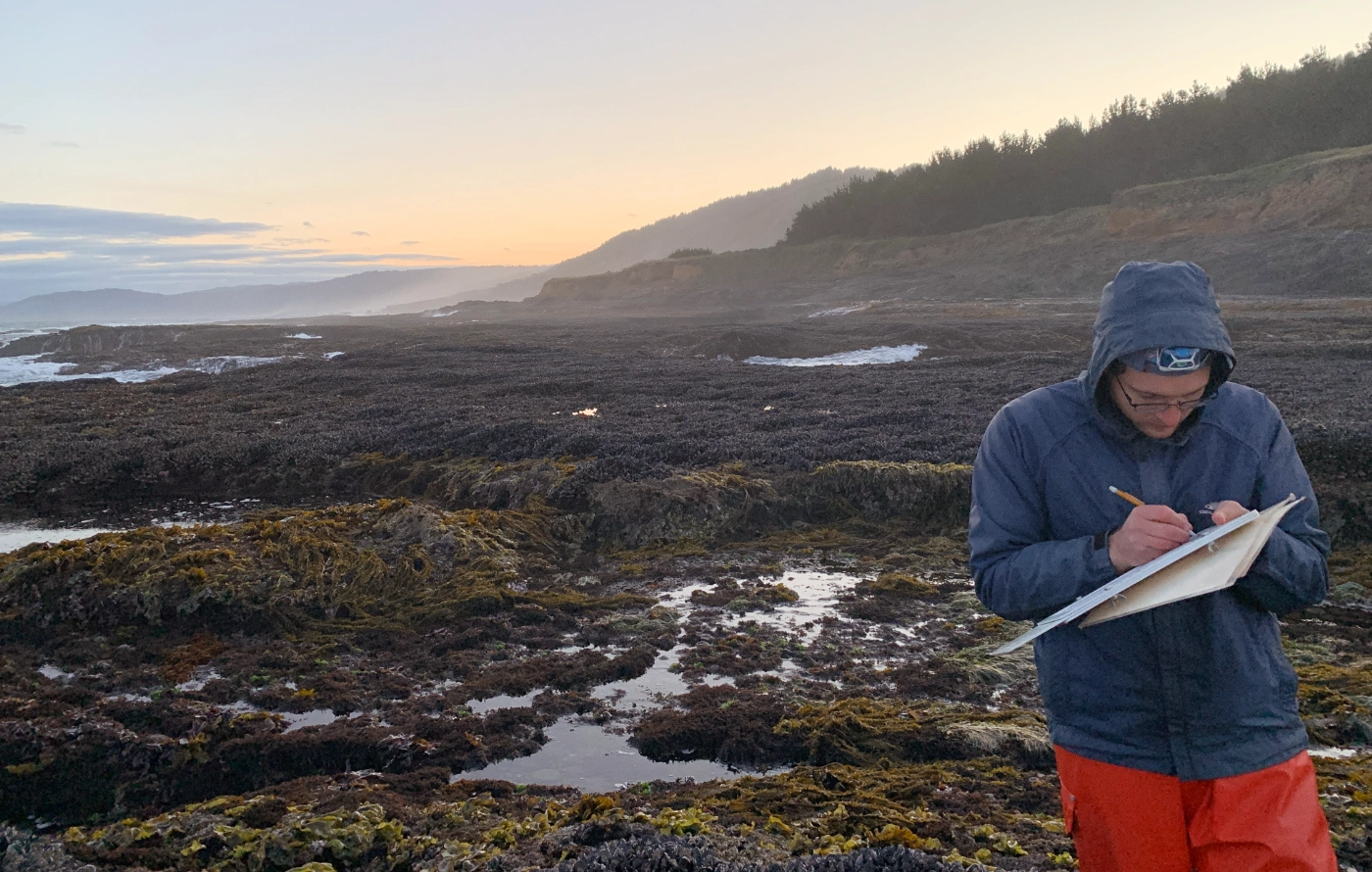
Unlike many quantitative ecologists, Meunier conducts his own field sampling (work he affectionately calls “extreme tidepooling”) to have a better grasp of the data. This is no small feat, considering his team camps at their field locations in order to begin their work at 4:30 in the morning or earlier.
Meunier’s field research is primarily focused on a long-term study called CRAZIE (community recovery in the algal zone interaction experiment), a project he has worked on for over 8 years and hopes to continue at Willamette for at least 30 more. Having taken over the experiment from his doctoral mentors at Oregon State University, Meunier envisions creating a dataset spanning over 50 years. The long-term experiment will now involve Willamette students for the first time this summer as part of the Science Collaborative Research Program (SCRP), during which they will study at 13 field sites on the Oregon and North California coasts.
“This is a manipulative experiment, meaning that we remove either invertebrates or algae and track how the species interact with each other over time,” Meunier says. “We've previously seen some dramatic changes as a result of a heat wave and disease outbreak that have impacted kelp, which impacts fisheries and recreational opportunities on the coast. I anticipate there will be more stressors or disturbances in the future that we want to track.”
“Given my position in the data science and computer science departments,” he adds, “I aim to collaborate with Professor Rachel Brown on a computer vision model for analyzing the 1,500 photos that we take this summer. It takes a lot of time for humans to process these images, so working with colleagues to develop the computer vision model to analyze the photos creates a pipeline that will speed up our process quite a bit.”
Ultimately, Meunier’s research will provide an ongoing window into major changes in a crucial part of Oregon’s ecology. The project will also work with organizations such as the Oregon Kelp Alliance and Oregon Shores Conservation Coalition to help drive policy decisions that preserve local environments.
“Willamette's great because it has such motivated undergraduates. Having the opportunity to work with stellar students is important to this work,” Meunier says.
As he finishes his first year of teaching at Willamette, Meunier will continue to contribute his multi-disciplinary work to the many environmental and data science learning opportunities on campus.